Monday, June 30, 2014

What should you read instead of The Oatmeal?

So maybe you're like me and you really enjoy webcomics. You find a unique appeal in the culture of creativity and humor and the accessibility of the artists to their fans through social media. Maybe you (unlike me, who has avoided this guy like the plague) are a reader of The Oatmeal by Matthew Inman. Maybe you were willing to accept his apology for his misogynistic comic in 2012 about women who play video games.

But maybe today was the last straw for you. Maybe you just can't support this man anymore, after he posted something this manipulative on his Facebook page:


Maybe it was initially difficult for you to extract the intent from image -- it seemed kind of misogynistic, or at least weird. But then you read the comments and Inman's replies to them:


Maybe you progressively begin to realize the point of it all: that Inman created and posted the image for the sole purpose of playing with women's feelings for his own fun and profit. Perhaps you just couldn't believe that this man would stoop so low as to purposely play dumb of his readers' practice of interpretive context (well, mostly the female ones) just so he could spring a loaded trap and confuse them or make them feel bad. Maybe the realization that this profoundly baffling degree of disrespect of his readers should be considered an economic decision of Inman's in that he makes money off of his pageviews and comics, just makes you want to, I don't know.. avoid Matthew Inman and his work like the plague?

Maybe you're extra upset at his male readers who understand what he did, but still view it as positive and your feelings as evidence of "prejudice":


Well, there's good news: there are lots of comics out there that are not actually created by sociopath creeps. Let's start with some awesome women:
  • Ashley Cope's Unsounded - a highly-recommended fantasy adventure, very funny and creative
  • Li Chen's Extra Ordinary - hilarious slice-of-life weirdness
  • Jen Sorensen - witty and award-winning political cartoons
  • Yuko Ota and Ananth Panagariya's Johnny Wander - biographical, funny slice-of-life (currently on a fictional story arc)
  • Momga - a Japanese mother's comic about learning English/slice of life
  • Kate Beaton's Hark! A Vagrant - historically fictional funnies, highly recommended
  • Saga, illustrated by Fiona Staples and written by Brian K. Vaughan -  not actually a webcomic, but you should go to your local comics shop and pick this up if you haven't. While you're there, check out Coffin Hill by Caitlin Kittredge

And some webcomics by men who don't seem like they'd pull the kind of garbage we've seen today:


--

I dedicate this work (“What should you read instead of The Oatmeal?”) to the public domain using the Creative Commons 0 declaration.


Wednesday, June 4, 2014

Why does #YesAllWomen exist?


I want to ask: why does the recent popular Twitter hashtag #YesAllWomen exist? Is it, as we would initially say, because of men's rapes, battery, stalking, harassment, and murder of women?

That's certainly what the hashtag is filled with: 140-character-or-less stories of daily terrorism and violence. No doubt, the hashtag and other writing surrounding the UCSB shooting has been inspiring women to air their thoughts outside Twitter as well, when normally, they'd have to expect their speech to be met with responses like.. well, like this comment I recently read from a man to a woman who shared a picture online:

"Wow. I've been taking in a lot of what you've posting [sic], and being cool about [it], agreeing, etc. But this is downright militant, extremely offensive, and probably the exact opposite of what you want to put out there in support of the cause.

If us men for the last half-century hadn't been standing guard, making sure our judgement of women's thoughts and speech about male violence and gender gets heard and taken into account, what would women's oppression be like today? Without the gaslighting and the tone-policing and the movement-hijacking, would women have been able to tolerate several more decades of the rapes, battery, stalking, harassment, and murder discussed daily on the internet and tabulated in all of the statistics, over the last 50 years?

No one can say for sure. But I believe not: Women wouldn't need a hashtag if it weren't for the kind of things we men did and still do to interject into women's movements to tell women how to run them. I think things would have changed between last century and today.

--

I dedicate this work (“Why does #YesAllWomen exist?”) to the public domain using the Creative Commons 0 declaration.

#AllMenCan?

A lot of the photos on the AllMenCan blog are nice! But also, a lot are not helping and serve as good examples of doing things wrong.

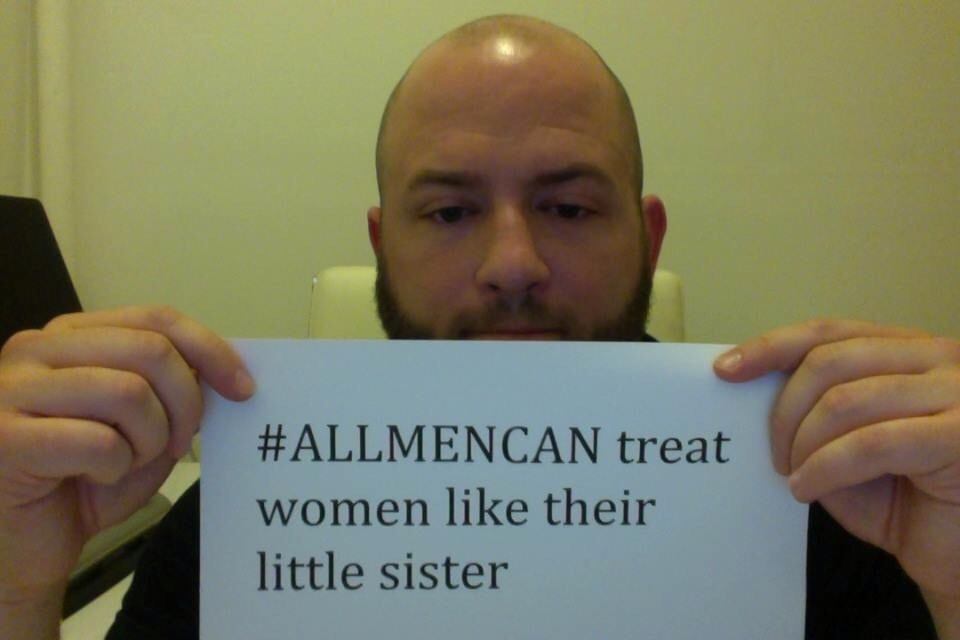
I won't try to tackle the massive amount of "#AllMenCan BE FEMINISTS" -- Meghan Murphy has already done the work in the past and these men should read her. I want to talk about stuff like this:


That's the pressing issue at hand. The past week on Twitter has been pretty much nothing but "#YesAllWomen hate that men can't wear women's clothes!" But really, leave it to us to make this about what we can or can't wear -- and swear and look upset while doing it. The thing is, we men do wear "women's clothes"; it happens all the time. Sometimes though, we're ridiculed and attacked for it. By other men. But our friend in the photo isn't going to talk about the perpetrators...

Let's move on to this creepy fellow:


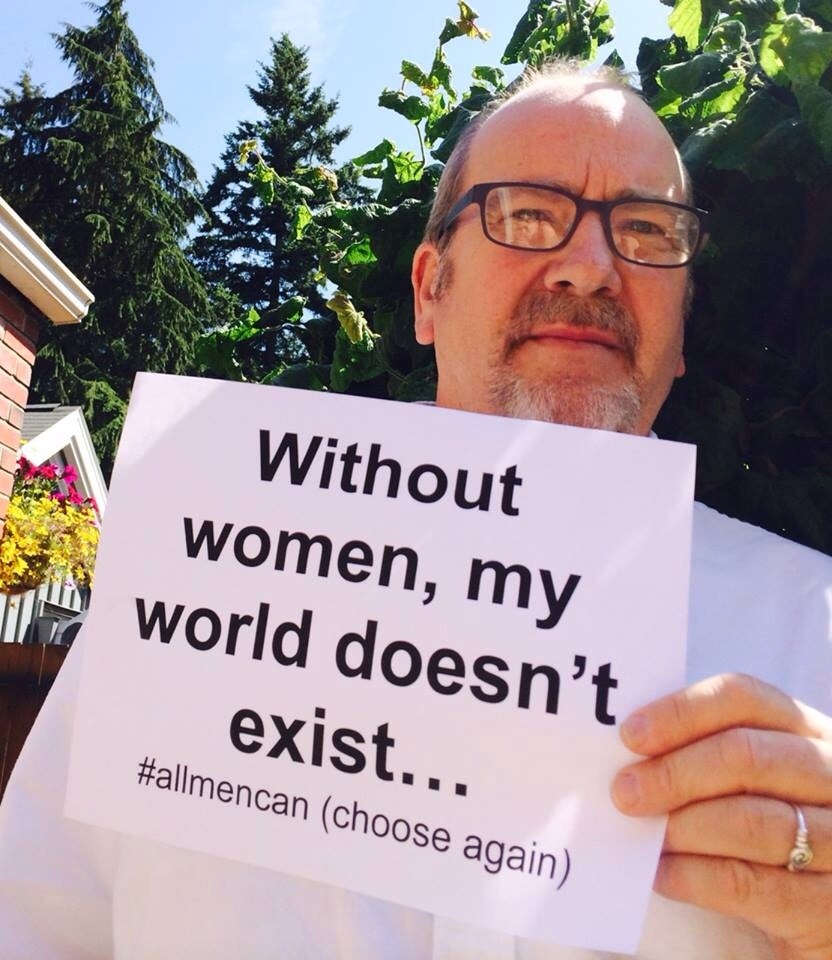
As if no young woman has ever been the victim of misogyny and male violence at the hands of her brother. How do you type this up, stand at the printer while it spools, and the whole time think "this is exactly what other men need to hear"? We need to dispense with the false strategy of leveraging familial relationships to try to get other men to stop hurting women. At least it's not what this guy came up with:


Oh, so women's value is contingent on the extent to which they provide you with life? How about "choose again". Once again, women's humanity is all about us men, rather than a self-evident fact.

I see a lot of this type of young man (offline and on). With it on the major points but still spouting the "consent is sexy" nonsense. I used to buy into the same slogans and it had to click for me with a short blog post that went something like: "stop saying consent is sexy. we shouldn't have to eroticize my human rights." Once again, we would rather leverage the power of an existing, male institution (sexuality in this case, family in the "little sister" case) to try to get men to stop raping, rather than try to create new power behind the notion that women are people. It's a nice maneuver from a marketing point of view but I don't think rapists are in the market.

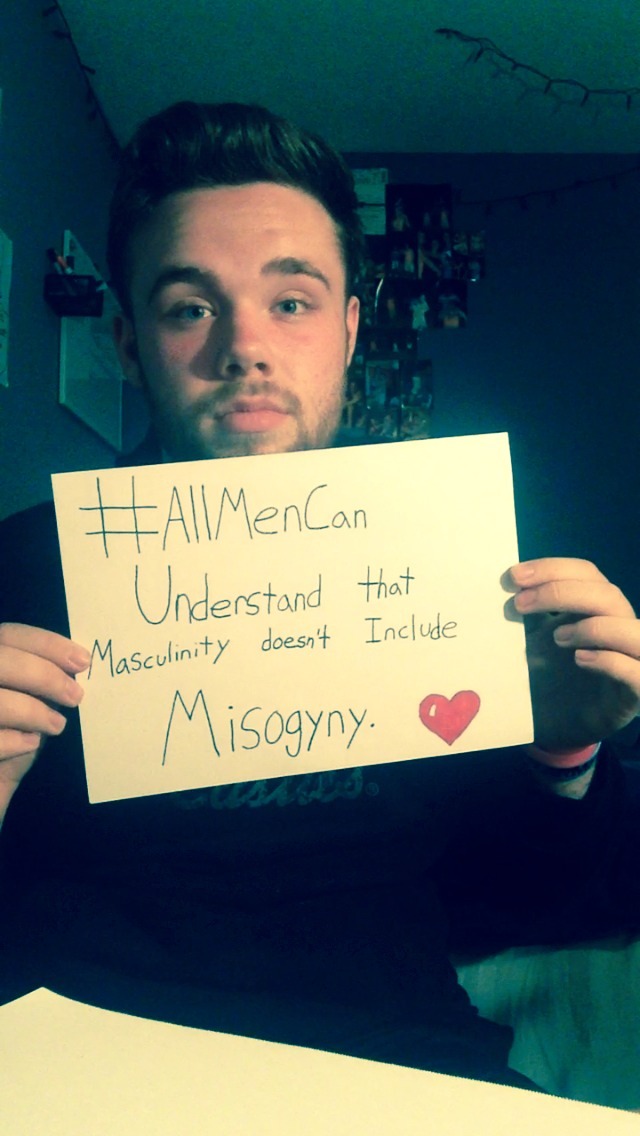
Here's an interesting one:


What's with this? I'm pretty sure masculinity only exists as a foil to femininity, a socially constructed script under which women are groomed for subordination in every way possible in that particular historical time and place. Here we have a fledgling Men's Studies scholar, and "it is time for the abolitionists to declare where they stand in relation" etc etc.

There actually aren't that many posts -- you can scroll through the blog in a few minutes. If you're a man, you should try to change that by submitting a photo. Just make sure it's actually about women.

Tuesday, June 3, 2014

How is this helping?

Sometimes, men try to criticize men who are (willing to act) degrees more misogynistic than them. We will do things like this:


Or we'll do things like Francois Tremblay does [warning: slurs]:
As you may remember, I published two debunkings of commonly circulated list of “proofs” by MRAs. This pissed them off, because they are whiny little bitches who cannot deal with any level of disagreement without believing that it’s all part of some great conspiracy against them. [...]
To all MRAs: try being real men for once and admit you’re a clutch of hysterical virgins who lie, cheat and threaten because you don’t have the testicular fortitude to face what woman-hating faggots you all are. Don’t like it, stop being one!
We'll think we're doing good. We sure showed those dudebros! We'll even imply that what we're doing is under the umbrella of "Radical feminism". (Francois Tremblay isn't a radical feminist and can not "do" radical feminism despite the amount of time he spends talking to feminists on the internets)

But how is this helping? What does it solve, to pin other men's worth to the extent to which they are performing heterosexuality correctly and sufficiently well? To put these slurs and violent masculine posturings in front of women's faces and into their spaces with the air of providing value?

Buying into the violent rhetoric of compulsory male heterosexuality is not distancing yourself from the systems that give that rhetoric its power. You can't do both. But as more men start to see radical feminism, and feminism in general, as something that makes sense, I can only imagine that talking about MRAs as "idiot f*ggot virgins" and rapists as "not being able to find a clitoris" will become more and more fashionable. And then we'll claim we're better people for it.


--

I dedicate this work (“How is this helping?”) to the public domain using the Creative Commons 0 declaration.

Sunday, June 1, 2014

Why is this funny?

Today's strip of the popular newspaper comic FoxTrot, written by Bill Amend since 1988, is, as usual, supposed to be a joke, particularly one appealing to tech-aware/geek crowd. I've written up the script below:
[Jason, the quintessential geek, and his friend Marcus, are watching TV on a couch]  
TV announcer: In Washington, the FCC finds itself knee-deep in public reaction to reports it may loosen, if not fully abandon, its stated commitment to preserve net neutrality and an open internet. 
TV announcer: Thousands and thousands of letters, e-mails and phone calls have poured in on a near-daily basis from aghast citizens, technologists, academics, and business owners, asking commission members to keep the internet's level playing field and non-discriminatory data practices intact. 
TV announcer: We are told, however, that the FCC has received a near-equal number of e-mails demanding an end to net neutrality, all from the same 14-year-old girl. "Making it so people can only wear neutral colors and taupe in their Instagram selfies is downright unamerican," reads one. 
Marcus: You probably shouldn't have told your sister that's what it meant. 
Jason: I was kidding Paige! I was kidding! 
Paige [off-panel, from upstairs]: (click) Send. (click) Send. (click) Send.
It's safe to assume that Bill Amend thought this would be funny, for reasons that are based in rational thought, rather than out of a random bout of writer's block or temporary insanity; he has been writing this comic for over two decades, and major newspapers continue to carry it. FoxTrot is popular among the geek crowd and has been printed in over forty books. It's also well-received among young children, if the note to parents in the Contact Info section of Amend's website is any indication. So if we can say that there are logical justifications for why he thought such a situation would be funny, what are they?

I want to start with the question: why does Amend make Jason's older sister Paige send a comically impossible amount of emails to the FCC, under the impression that the term "net neutrality" meant a government-enforced social media dress code? Why wasn't it Jason's older brother Peter, who often shows his gullibility as well when it comes to the latest technology? Could the script be rewritten with "Peter" and "brother" swapped in, and still make sense as something Bill Amend would come up with?

No, and we know why. Paige is the caricature of a 14-year-old girl, and, in this particular instance, she is taking the ubiquitously understood phenomenon of young women's interest in "fashion" to the logical extreme. We know this trope. Young girl obsessed with social media photography and the entailing fashion concerns, to the point of hilarity. *rimshot*

Obsession with physical appearances is also a supposedly widely shared characteristic in women that men like the UCSB shooter would outwardly admit to as a symptom of women's believed inferiority and/or stupidity. Men assert that women are vain and trivial for spending so much time, money, and energy on the visual presentation of their bodies and the bodies of others. Interest in fashion is widely understood to be a "womanly" quality. When gay men are "into women's fashion", the mainstream understands it as partaking in realm of femininity that straight men would never be caught in. Meanwhile, internet articles on "millennials" are littered with stock photos of young women using smartphones and cameras, and shopping for clothes.

Many women, on the other hand, understand female teen concern with fashion as the product of childhood socialization, as facilitated by parents, older peers, and the media. Laura Bates writes on how the (pre-)teen fashion industry and culture of "telling girls to make themselves sexy" has flourished on the internet, examining specific websites in the UK:
Over on the website of Top Model Magazine, another big hit with the tween age range, girls learn that "Mascara alone is not enough! You need more to achieve a radiant look!" There are even tips to get rid of cellulite by "pinching yourself with a twisting hand movement". Because they might as well learn young that inflicting pain on oneself in the name of beauty is a woman's lot.
It is for this reason I don't see how caricaturing of this facet of girlhood is amusing at all. It is only in a context of sex-based oppression that men could make a joke of the sort of the terrorism young girls face daily. Emma M. Woolley writes:
We don’t talk honestly enough about what it’s like being a teen girl. If we did talk about it, what it was like for us, perhaps we wouldn't be so harsh on them. Perhaps we wouldn't throw our hands up in the air and exclaim “oh, teen girls, they’re so difficult!” Perhaps they wouldn't be so scary. Perhaps we’d see their lives for the small and large violations they’re often made up of; and what those violations do. 
Maybe if more of us men were willing to listen to women talk about girlhood, the dangerous emptiness of socialized concern with appearances in the context of the male gaze would not be appropriated by men for fun and profit as Amend has done; or at least such scripts and tropes would not be considered funny or acceptable to depict in a medium usually meant to entertain children. In a 2010 interview, Dr. Leonard Sax, author of Girls on the Edge, said (emphasis added):
Girls spend a lot of time photoshopping their pictures, making themselves look a little bit thinner than they are and getting rid of the pimples, because they know boys are interested in the photos on these sites. So you’ve got 14-year-old girls essentially presenting themselves as a brand, trying to create a public persona, polishing an image of themselves that’s all surface: how you look and what you did yesterday, not who you are and what you want to be. And that leads to a sense of disconnection from themselves, because in most cases, these girls don’t even realize that their persona is not who they are. They’re just focused on striving to please their market and presenting the brand they think will sell. It’s one thing for Angelina Jolie to be doing this—she’s an adult—but it’s really toxic for a 14-year-old. It gets in the way of the real job of adolescence, which is figuring out who you are, what you want, what is your heart’s desire. [ed. note: "heart's desire"? "real job of adolescence"? What? I think the doctor should stick to talking about gender socialization...]
In 2012, New York Times columnist Randye Hoder wrote in her article "For Teenage Girls, Facebook Means Always Being Camera-Ready" (emphasis added):
Trying on 10 outfits and staring critically at the mirror before leaving the house is practically a teenage rite of passage. But these days, girls know precisely how their peers are judging them, thanks to the “Like” button on Facebook. “When I choose my profile picture, I want people to ‘Like,’ it,” said Grace. In fact, she and her friends are keenly aware of how to goose the numbers. “You get more ‘Likes’ if it’s a model shot and not a goofy picture with your friends,” she explained.
The formula is simple: The more “Likes” you get, the more popular you appear. “Girls don’t just want to get ‘Likes’ from their close friends,” said 14-year-old Lily. “They want to get them from boys, or older kids or kids from other schools who are popular.”

14 years old -- hey, that's how old Paige is. Is any of this funny?

Sunday, January 12, 2014

What do people mean when they say "I'm not surprised by the NSA revelations"?

In part because of my unhealthy infatuation with most things that Glenn Greenwald writes and does, I've been following the Snowden leaks and most of the little details about them since they began in June last year, and sometimes I glance at the comments sections of articles or Youtube or skim stories that I don't really care about and there's this very interesting ubiquitous trend where some people declare "I'm not surprised about any of this" and then just leave it at that, or talk about something else in a new paragraph.

What is the purpose of this? People do things because they feel uncomfortable with the prospect of not doing them. More specifically, it seems that when people are in settings where they know other people will see what they do, they behave in a specific way that they believe they should, to satisfy how they want to be perceived. Social theory often refers to this as "performativity." People feel the need to air this declaration before going to do something else. What are people "performing" when they say "I'm not surprised about any of this"?

When people write their version of that specific sentence, they have in their mind the people who are going to read it. They think something along the lines of "lots of people on the internet are going to read this and [something]".

What I think that "something" is, is something along the lines of "a lot of people are going to agree with me and give me upvotes or props," and/or "the people who are acting surprised and excited are going be humbled by my cynicism/complete lack of emotion." It's perhaps sort of a modification of macho superiority. People who are acting surprised and excited must be more childish than I, less worldly than I, and so I must be a good role model and donate my comment to the unwashed, illiterate masses.

She's not surprised about what Snowden revealed either

So from what I can tell, either these people fundamentally misunderstand the point of why other people are acting surprised and energetic (because they think things should change ASAP), or they understand it and wish to exploit it for their own benefit (pretty much just +1's on a website) and/or for empty boosts of self-esteem. Maybe both sorts of people are making this comment.

I'm not surprised by the NSA revelations. When I read each article as it came out, I didn't gape at my computer screen, I didn't leap out of the proverbial bathtub and go running through the streets naked. What I felt like doing: I felt like learning cryptography programming, I felt like going to the DC protest (but didn't make it), I felt like talking to people I know and writing about the issue, I felt like helping my friends secure their computers. What I didn't and still don't feel like doing, is making sure that the world knows that I was/am not surprised. Some people are at a young age or have other things on their plate and simply have not had time to read all the books you have.

This kind of flamboyant posturing often betrays a smug sort of attitude, shared by people all across the political landscape, that posits that focusing on the NSA is futile, for any number of reasons depending on the person. Things like:

  • What we really have to do is overthrow capitalism
  • These kinds of programs have been targeting non-white people forever, so the focus now is invalid
  • What we really have to do is reduce/get rid of the government
  • The Constitution is broken and failed anyway

To me this is like proclaiming that rape victims shouldn't go to the police because the police are historically and presently bigoted racially, and protectors of the ruling class. However accurate a description that might be, rapists pose a real threat and law enforcement has power to protect rape victims. The NSA specifically poses a real threat to real people, and most people find the US Constitution a good ideal for a country to aspire to. Now we need a mass of people to see the connection there, between the NSA and their supposed rights, and what are you doing? If you've ever left a bare "I'm not surprised by any of this NSA stuff" declaration anywhere (before now, obviously), or written a piece where you declare as much, leave a comment linking to it and then tell me what you've subsequently done for real people.

I wrote this without really knowing where it was going to go -- sometimes thinking flows better when I'm writing it out (i.e. Graham's The Age of the Essay). I don't actually know why people make this sort of comment. I just think this particular phenomenon I'm talking about is a good crystallization in which we can see the reflection of what most people aren't doing: learning more, building more alternatives, finding ways to help radically change the way things are in the US government, that allow the NSA to be the way it is.

Friday, July 26, 2013

Where is 2009's John Boehner when we need him?

I was reading a particularly good (albeit imperfect) article about President Obama's Trayvon Martin speech by Esther Armah, and an interesting statement caught my eye:
[Salon.com columnist David] Sirota cited the 2009 report from the Department of Homeland Security, Rightwing Extremism: Current Economic and Political Climate Fueling Resurgence in Radicalization and Recruitment. That report came within the President's first 100 days in office and was aimed at giving law enforcement what then Homeland Security Secretary Janet Napolitano called "situational awareness." The report cited the recession, the election of a black president and disgruntled veterans as fodder for growth in extreme groups. Oklahoma bomber, Timothy McVeigh had been a decorated Gulf War veteran before killing 168 people during the bombing of the Alfred P. Murrah Federal Building in Oklahoma City in 1995. Napolitano's report sparked widespread outrage from right wing media, veterans groups and Americans across the board. Republicans called for her to step down. Then House Minority Leader John Boehner said: "I just don't understand how our government can look at the American people and say: 'you're all potential terrorist threats.'" The outcry prompted an apology by Napolitano.
This is mid-2009. Since that time, it seems that House Speaker John Boehner may have gained the understanding he claimed to lack:
The House voted 205-217 Wednesday and defeated an amendment to the roughly $600 billion Department of Defense Appropriations Act of 2014 that would have ended authority for the once-secret spy program the White House insisted was necessary to protect national security. [...]
House Speaker John Boehner (R-Ohio) voted against the measure. He ranked 15th in defense earnings swith a $131,000 take.
What was so unappealing about this amendment? All it would do is restrict the NSA's domestic spying from treating all U.S. citizens as potential terrorists, which it does, as recently revealed by documents leaked by Edward Snowden to the Guardian -- particularly, the dragnet of phone records through an order to Verizon.
Under the Patriot Act, the government only needs to show that the information is “relevant” to an authorized investigation. No connection to a terrorist or spy is required. The amendment would effectively gut the dragnet phone-metadata program that commenced following the 2001 terror attacks by only authorizing the metadata snooping against specified targets that are “the subject of an investigation.” [via]
Should we be surprised? In 2009, Boehner was tasked with responding to the outrage of his voter base: church-going white veterans. This month, his task was to defend those who pay for his campaign and offer him industry positions after he leaves office. That is how you make money in Washington.

Saturday, June 29, 2013

Why is Larry Lessig plugging Palantir?

Update (6/30): Professor Lessig has posted a response on his blog, which I thank him for. Providing some disclosure, he states that he has "a high regard for [the] integrity" of the two people from Palantir he knows personally.

Update(7/2, 3:30pm EST): Lessig is currently doing an AMA on reddit.com; it's not really related to this article, but if you'd like to ask him anything or read his current responses, it's there.

Prof. Lessig, I'm a big fan. Your TED talk had me floored; never had I seen someone elucidate the problem of campaign finance ("legal corruption" as you put it well) in the US and its consequences so effectively. When I saw you had been interviewed by Bill Moyers (me being subscribed to your blog by RSS, and all), I promptly set the video aside for later watching.

But today, a colleague of mine who got to the interview before me noted that during your exchange with Moyers on the topic of pro-privacy software development, around the 13:30 mark, you mentioned a very interesting company:
And the reality then is that if we don't have technical measures in place to protect against misuse, this is just a trove of potential misuse. Now, that's the part that really frustrates me. Because, I wrote a book in '99 called Code and Other Laws of Cyberspace. My point from the very beginning has been we've got to think about the technology as a protector of liberty too. So code is a kind of law. And the government should be implementing technologies to protect our liberties. Because if they don't, we don't figure out how to build that protection into the technology it won't be there. And what's frustrating to me is to hear a description of a system where we don't have any infrastructure in place really to protect the privacy. We have infrastructure in place to facilitate the surveillance. When there are plenty of entities out there, companies like, there's a company called Palantir who's built a technology to make it absolutely, make you absolutely confident that a particular bit of data has been used precisely as the government says it's supposed to be used. You can find out exactly who's looked at it and for what purpose it's been used at. So the point is there's a way to build the technology to give us this liberty back, this privacy back. But it's not a priority to think about using code to protect us.
Indeed, reading your piece at The Daily Beast, it seems that this company is the only one you can think of that can give us hope in our age of an internet in want of privacy protection.
Because the fact is that there is technology that could be deployed that would give many the confidence that none of us now have. “Trust us” does not compute. But trust and verify, with high-quality encryption, could. And there are companies, such as Palantir, developing technologies that could give us, and more importantly, reviewing courts, a very high level of confidence that data collected or surveilled was not collected or used in an improper way.

But.. Palantir? You mean Barrett Brown's Palantir?
Indeed, in an e-mail from Aaron Barr of HBGary Federal to Matthew Steckman of Palantir Technologies, Barr makes the case for subverting WikiLeaks and its supporters in the “liberal” media–and discusses plans to “attack” then-Salon columnist Glenn Greenwald.
... 
Palantir Technologies ... was founded in 2004 with funds from the venture capital firm, In-Q-Tel, to develop software for fraud detection. In-Q-Tel is a non-profit investment firm chartered in 1999 at the request of the CIA director. In-Q-Tel’s investment is run through In-Q-Tel Interface Center (QIC), an office within the CIA. Trustees from In-Q-Tel hold executive level positions at companies such as Netscape, Sun Microsystems, Time Warner, Federal Express, ATT Wireless, and New Enterprise Associates. Most of its current investments are in the biotechnology and IT/communications industries.
No, it couldn't be that company..

Palantir, which received seed money from the CIA's investment arm, In-Q-Tel, and shares founders with PayPal, made a public apology to the effect that the cyber-plotting did not reflect the company's values, and put one of the employees involved, Matthew Steckman, on leave. A few months later, when the press had lost interest, Palantir brought him back on. Nothing at all seems to have happened to another employee, Eli Bingham, who was also heavily involved. When Palantir throws its annual convention, it still attracts keynote speakers like former DHS Secretary Michael Chertoff – who happens to be on the board of another huge contractor, BAE Systems, which, in turn, happened to have done some business with HBGary Federal, as well. 
Yes, BAE Systems, which just yesterday won $296 million in contracts from the Pentagon for communications tech, to add to its other multi-million dollar deals to make body armor and missile materials.

I would think that you would be familiar with Barrett Brown. He's a young white male subscribing to an ideology demanding the transparency and freedom from corporatocratic corruption, currently facing charges from the government for hacking...

Did you maybe know of Brown's story and forgot Palantir's name for the moment, hear a cool speech on your recent trip to the Bilderberg meet (where you and Palantir's CEO likely met), and didn't think to Google DuckDuckGo websearch the name before you went on television and.. let's call a spade a spade, plugged it? Even then, it's a little bit fishy.

Edit: oh boy, didn't expect to hit the front page of HN.. users commenting noted something that I should have included: Palantir apparently "cut all ties" to HB Gary and apologized for the whole Glenn Greenwald thing, according to this article. More discussion here. However, the quote from the 2012 Guardian article by Brown still stands. As does the millions of dollars in government contracts since the apology:
But perhaps more relevant is Palantir’s primary focus: working with the national security apparatus. They’ve done at least $6,378,332 in business with entities like SOCOM and FBI in the last several years. And while they say they have no plans to adopt “offensive cyber capabilities,” that’s not to say they’re not helping the government analyze data on our presumed enemies.
In 2012, they did even better:
Palantir Technologies, Palo Alto, Calif., was awarded a $19,242,997 firm-fixed-price contract.  The award will provide for the procurement of Palantir core CPU server licenses, field service representative support and server hardware.  Work will be performed in Palo Alto and Afghanistan, with an estimated completion date of Sept. 27, 2013.  One bid was solicited, with one bid received.  The U.S. Army Contracting Command, Adelphi, Md., is the contracting activity (W911QX-12-F-0022).  
And if this website is reliable, we have $52 million total from 2000 to 2012.

Edit #2: My colleague alerted me to this article at BusinessWeek about the company, which includes this gem:
Soghoian points out that Palantir’s senior legal adviser, Bryan Cunningham, authored an amicus brief three years ago supporting the Bush Administration’s position in the infamous warrantless wiretapping case and defended its monitoring domestic communication without search warrants.
Cunningham's LinkedIn shows he's "Senior Advisor" at the Chertoff Group, a firm known for representing (and hyping) companies that make full body scanners for airports. Is this the kind of setup Prof. Lessig wanted to foster with Rootstrikers? Maybe he just likes Palantir's people: four out of five of the founders -- Stephen Cohen, Joe Lonsdale, Peter Thiel, and Alex Karp -- are from the law school where he used to be a professor.

I should note again that I respect and admire the professor for the work he's doing; his campaigning for Aaron and for election finance reform are exactly what we need. But the plug of this particular company, in tandem with the Daily Beast article, left me confused. Especially with Palantir's campaign contributions to Adam Smith, affiliate of the American Defense & Military PAC, along with now-president Barack Obama, senator and ardent NSA defender Dianne Feinstein, and the "Promoting Our Republican Team" PAC -- this from a company started with CIA seed money.

About Me & Links

A young man